Industry Update: VDA 5050 Tugger Train Standards Drive High-Throughput EV Battery Logistics
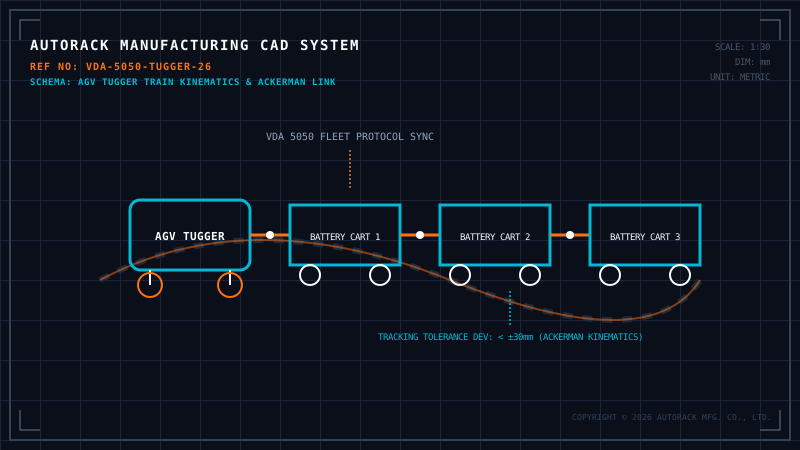
Automotive logistics is undergoing a standardized revolution. As global Gigafactories ramp up EV cell and pack production to meet gigawatt-hour (GWh) capacities, material handling workflows are shifting from manual forklifts to automated, VDA 5050-compliant tugger trains. This update analyzes the intersection of automated communications and heavy-duty mechanical cart design.
1. The Role of VDA 5050 in Automated Tugger Trains
The VDA 5050 standard (developed jointly by VDA and VDMA) defines the standardized communication interface between Automated Guided Vehicles (AGVs) / Autonomous Mobile Robots (AMRs) and the central fleet controller. In an EV battery assembly line, a single AGV tugger pulling up to four heavy-duty turnover carts must dynamically receive route instructions, obstacle stop signals, and decoupling commands. Standardizing this protocol allows manufacturers to mix AGV brands on a single factory floor.
2. Kinematic Challenges of Heavy-Duty Battery Pack Loads
Lithium-ion battery packs weigh between 500kg and 1,200kg. Pulling a train of four battery carts (totaling up to 4.8 tons) requires meticulous kinematic engineering:
- Ackerman Steering Linkages: Carts must track the AGV path within a maximum lateral drift of ±30mm in corners to prevent collisions in narrow line-side lanes.
- Polyurethane Caster Hardness: We specify 95 Shore A polyurethane treads cast onto forged steel cores, featuring precision tapered roller bearings to keep starting roll resistance under 1.5%.
- UL94-V0 ESD Isolation: Workstation presentation trays incorporate conductive ESD-safe polyurethane and dielectric isolation barriers to prevent static build-up and arc flashovers during high-voltage cell handling.
Technical Q&A Section
Q: How does VDA 5050 compliance impact B2B logistics cart hardware design?
A: VDA 5050 defines the software interface, but hardware must adapt by integrating electronic lockpin sensors, retro-reflective laser targets, and automatic spring-loaded towbars that receive mechanical release triggers from the AGV command center.
Q: What safety margins are required for 4.8-ton battery towing trains?
A: According to European EN 1525 standards, towbars must feature a structural safety factor of 3:1 under static pulling forces and 1.5:1 under dynamic emergency braking deceleration (up to 2.5 m/s²), utilizing high-yield strength Q355B steel profiles.
Q: How does the Ackerman link configuration reduce tire wear on heavy logistics carts?
A: By angling the steering knuckle arms, each cart’s wheels turn at matching concentric radii relative to the tugger’s pivot center. This eliminates side-slip and tire scrubbing, increasing polyurethane tread lifecycle by 60%.
Contact ccw@autorackmfg.com for VDA 5050 tugger train compatibility schematics and CAD design requests.
Ready to design your custom steel equipment?
AutoRack provides custom structural fabrication. Work directly with our CAD engineering team to draft custom trailer carts and stackable turnover racks.